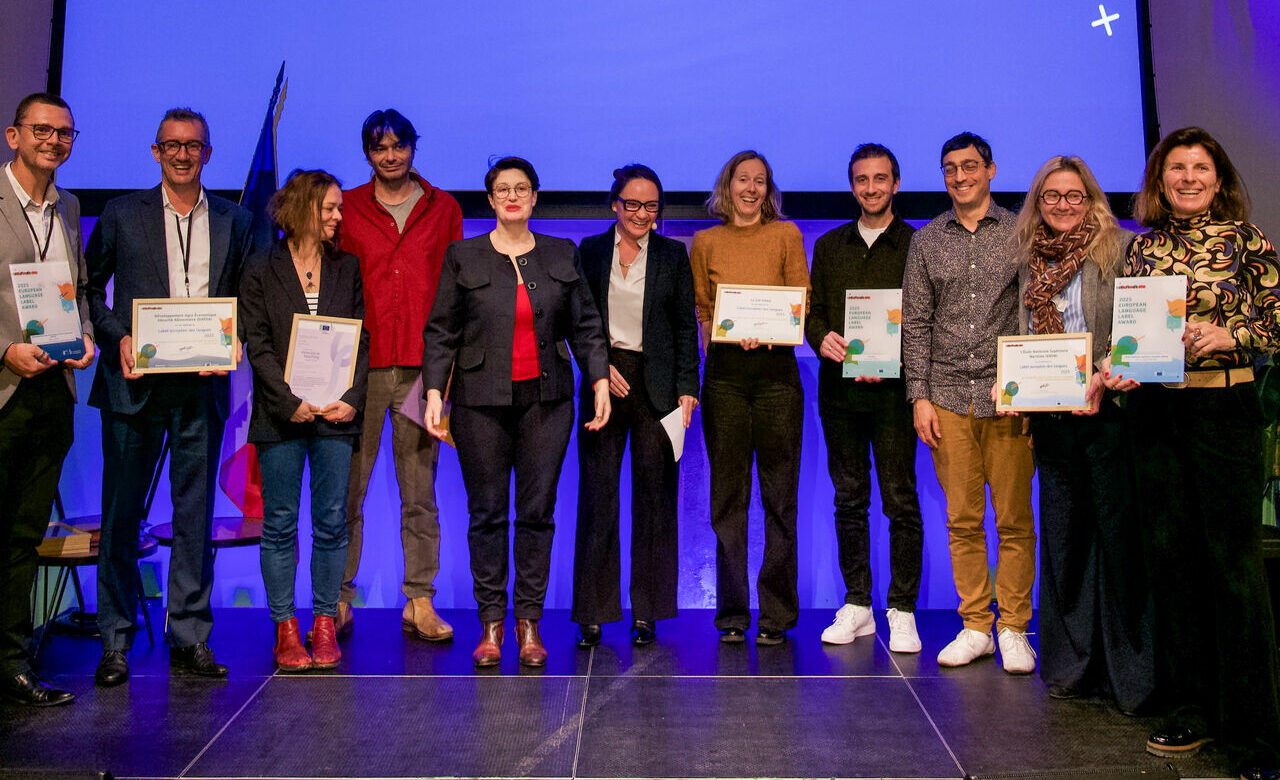
The MAR-Lang project awarded the European Language Label 2025
On 2 December 2025, ENSM, the French National Maritime Academy, was honoured at the 2025 Erasmus+ Annual Conference. On this occasion, Gersende Le Dimna, Head of International Relations and Academic Partnerships, and Christelle Nicolas, maritime English teacher and project leader, received the ‘European Language Label’ award in the higher education category on behalf of the school. The award was given to the MAR-Lang project, co-funded by Erasmus+. Presented by Nelly FESSEAU, Director of the Erasmus+ France / Education Training Agency, this label is a prestigious distinction created by the European Commission. It rewards exemplary projects that stand out in particular for their pedagogical innovation.
The ceremony also provided an opportunity for ENSM to exchange ideas with other winners from Mayotte and various regions of mainland France, illustrating the richness and diversity of the initiatives supported by Erasmus+.
“ENSM is proud to have received the European Language Label 2025 for our MAR-Lang project, the first Erasmus+ Key Action 220 project that we coordinate, awarded on 2 December in Paris. This bilingual open source platform on maritime terminology reinforces our educational innovation and opens up new European collaborations thanks to the increased visibility provided by this label. I would like to sincerely thank and congratulate the entire team that worked on this project, the ENSM teachers, foremost among them Christelle Nicolas, project manager, and our partners, as well as the students and administrative staff who were involved.”
Gersende Le Dimna, Head of International Relations and Academic Partnerships
“For me, as the head of this project, this award was the culmination of two years of teamwork with our two European partners, the Romanian Naval Academy and the Lithuanian Maritime Academy. MAR-Lang was a long-term project, the result of which is a Moodle platform for learning maritime terms in French and English, available in open source and accessible to anyone wishing to learn or improve their maritime French and English.”
Christelle Nicolas, maritime English teacher and head of the Marlang project
À propos du projet MAR-Lang
Led by ENSM in collaboration with the Romanian Naval Academy (RNA) and the Lithuanian Maritime Academy (LMA), MAR-Lang has resulted in the creation of a bilingual Moodle platform (French/English) dedicated to learning and improving maritime terminology. This initiative serves students, teachers and professionals in the maritime world.
Mar Lang: A digital environment for maritime learning
In the maritime world, where precision and rigour are essential, training cannot be limited to simply imparting knowledge. It must be based on educational tools that stimulate attention, reinforce memorisation and promote learner autonomy. This is precisely what the MAR-Lang project’s learning environment and resources offer: a comprehensive, user-friendly and engaging educational package designed for the seafarers of today and tomorrow.
One of the great strengths of this tool lies in the diversity of resources and exercises it offers. Cognitive science has shown that varying the media and tasks (quizzes, essays, diagrams, case studies, problem solving) increases the number of reminders of the same concept, which consolidates memory traces and promotes long-term memorisation. This variety also allows for differentiated teaching, offering everyone the opportunity to learn at their own pace and according to their cognitive profile. Students or trainees can work on several skill levels – recalling, applying, analysing – and find the approach that suits them best.
Key resources include an online Larousse dictionary with 150,000 definitions, available in bilingual versions in several languages, as well as a translator and conversation guides. These tools facilitate the acquisition of technical vocabulary and international communication, which is essential in a sector where crews are often multicultural. Flashcards offer a fun and effective approach based on the principle of spaced learning, which is particularly well suited to language study.
The environment also offers an encyclopaedic section, allowing everyone to deepen their knowledge according to their interests, from general culture and civilisation to the most technical aspects of navigation and maritime engineering. Each text or description is accompanied by a questionnaire that promotes immediate recall and better understanding. Automatic corrections and detailed feedback further enhance the tool’s effectiveness.
The structure of the courses is another major advantage.
The ‘Ship Description’ module has a clear summary detailing the points covered. Technical terms are systematically associated with a definition and a voice synthesis to ensure correct pronunciation. The materials are varied – texts, diagrams, audio tracks, photos – in order to engage multiple cognitive channels. Fill-in-the-blank exercises complement the training, reinforcing comprehension and memorisation. Finally, a final assessment allows learners to test their knowledge and validate their skills.
“This digital environment is therefore a valuable training companion for sailors, which they can use every day at their own pace.
It combines ergonomics, rich content and interactivity, creating an environment conducive to independent and sustainable learning. By incorporating insights from cognitive science and offering a range of resources tailored to the realities of the profession, it helps to train professionals who are able to navigate with confidence in an ever-changing maritime world. “
Frédéric Dupont, educational engineer
This distinction marks an important milestone for ENSM and confirms its commitment to developing innovative, open and collaborative educational tools for European maritime training.